Showing posts sorted by relevance for query Run Morris, Run. Part. Sort by date Show all posts

Run Morris, Run. Part 1

Hello visitors,
So ever since I posted my latest demo reel from "The Fantastic Flying Books of Mr. Morris Lessmore", I've been receiving a lot of nice emails complimenting and asking me about the spinning house shot, so I decided to start a series of posts explaining the way I approached that shot.
When I first watched the full animatic of the short, a couple of shots stood out to me as "Vague" or "jumpy", and the spinning house shot was one of those shots. For the record, I'm not discrediting our story guys at all, they actually did a phenomenal job turning the boards into a solid animatic, it's just when you watch your own work for so long you lose sight sometimes, and that's why you always need a couple of fresh eyes to judge your work, so here's how the shot looked like in animatic.


You may have noticed that the shot initially was supposed to be two shots, one shot of Morris crashing into the house and popping out of the window then climbing over the roof, and the second shot is a close up of his profile running after his book (Which is off-screen) and slowly revealing the house spinning and reeling in his book. The jumpiness to me was in the cut (Wide shot 3/4 behind to close up on profile) and the vagueness was in the action, personally I didn't feel the importance of that book to Morris, I didn't see how badly he wanted his book back, and he didn't try hard enough to catch it, in short the shot was all about the gags and little about conveying information, so I asked the directors to allow me to take a shot at it and plus it up, and they thankfully agreed.
The points I wanted to fix were clear to me:

1- Simplify the light post crash and Morris's landing on the house.
2- Make sure the book is in frame and show how important it is for Morris to get it back.
3- Get rid of the jump cut.

With all that in mind I made sure that the initial performance wasn't entirely redone, and most of it made it into the final product, after all it wasn't bad, it was just incoherent.
Since I had a clear idea of what I wanted to do with the shot I started reworking the layout and the camera in 3D directly (camera and house only) I figured out the composition, the timing of the crash, the slowing into the spin, how many spins, and how far in the distance do I let it go, all of which is very important specially that the house motion effects Morris's performance a big deal.
I showed the directors my first pass, and they gave me a couple of small notes, I addressed them and kept moving into figuring out the performance.
Animating shots like the spinning house shot can be a nightmare sometimes, high physical action, floating in space, interacting with another floating object with multiple constraints, so I needed to be really organized while finishing this shot, and in order to be efficient I decided to block this shot in 2D -an old trick I learned while working on "Cloudy with a chance of meatballs"-.
I rendered out a playblast of the new layout, and took the frames into a traditional animation software (TVPaint) and I blocked in Morris's performance with drawings and exposures, this way I can communicate my ideas to the directors very quickly and in case of any major notes the fixes can be addressed in no time. So here's my 2D blocking pass.


A couple of thing to note here, The length of the initial blocking is much shorter than the final outcome and that's due to many more notes I got down the road, so if you would like to read more about this shot come back in next week, till then, keep it up.
Run Morris, Run. Part 2

Hello again:
I'm very glad to see the number of visits my blog has gotten over the last week, this only makes me want to write more.
So last week I left off at the approved 2D planning phase, this week I will be talking about the jump into the 3D blocking which took me a little longer than I anticipated due to the set up of the shot.
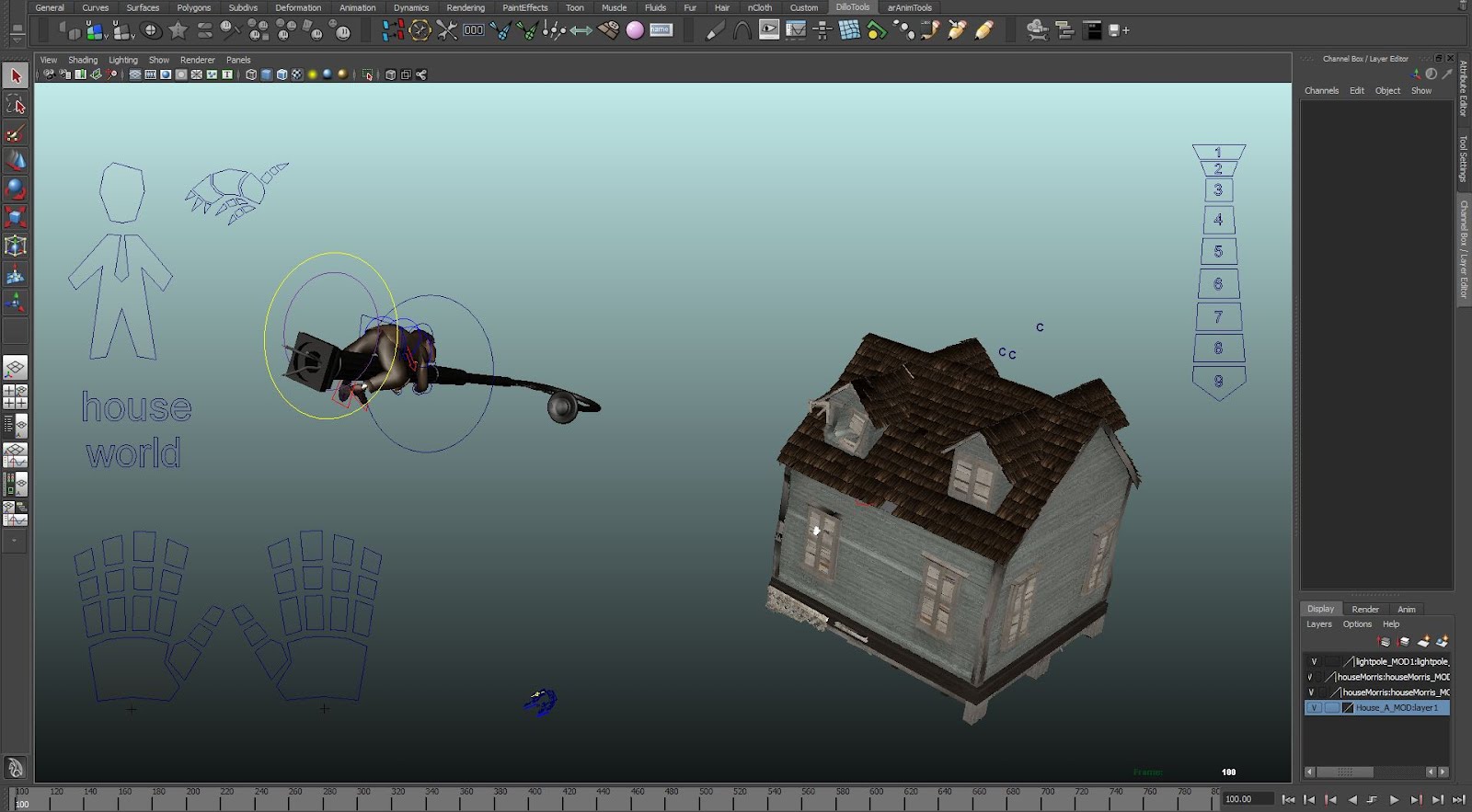
Since Morris was hanging on the light post at one point, and then had to run on the house at times and jump freely in the air at some others I had to use 3 different constraints with space matching function, thankfully our TD masters helped me setting up something "animator friendly".

This is how the scene looked like. The UI World/House were set up to help switching spaces. Thanks to Bohdon Sayer.

After that was done I went through our reference folders "Which were loaded with Buster Keaton pictures and videos" and I collect all the material and the poses I liked to include in my shot (some of which were full poses and some were little details and nuances that Buster was known for) , so here's my 3D blocking.


As you see, my 3D blocking was very close to the initial 2D planning that was approved earlier in the game, in fact it was identical, but that didn't mean the directors were going to let it go easy, which is something I learned more about as time passed by; you do something good (anything, animate, light, composite) the directors love it and give you the go ahead then they see it again with a fresh pair of eyes and they want to either "plus up the shot" or add their own touch to it because good is not good enough, it has to be great, and this may feel frustrating at times but we must GET OVER IT, it's easier that way.
So after my 3D blocking was green lit I progressed into breaking it down even more just so I have total control over my performance. Remember those 3 constraints? animating with constraints requires a lot of control, a lot of key frames and a lot of organization (Which constraint turns on and which one turns off and what frame do they switch on) it can get super angering sometimes. For some reason I don't have the stepped mode 3D blocking with breakdowns so I'm posting the spline mode, which was the scariest thing I had to clean up, here it is.


Did you see this? changes were added to the shot after the breakdown phase was done, here are the changes I was asked to do:

1- on frame 3-4 when Morris rotates down gymnastically to sit on the edge make him hold longer on his arms.
2- on frame 21 don't let him hit the window cause it feels too dangerous and impossible to recover from, instead make him jump high with his legs spinning (Keaton like cartoon gymnastics).
3- the house seems too light, it flies away too fast slow it down.

While the directors were thinking about plussing up the overall feel of the shot, I was thinking mainly about plussing up the performance -after all I am the actor here- so I went in and added what I thought is needed for the performance to read well:

1- as he's getting up Morris's eyes were too locked on the book, and considering he's on a the roof of a floating house in the sky he needed to be a bit more cautious so I changed the eye direction to the roof where he was stepping which made him look a bit more aware of what he's about to do next.
2- on frame 14 when he slid on the shingles I decided that a slide of that magnitude needed an over shoot on the arms and a circular swing to balance himself which in my opinion looked real good at that point in the shot.
3- after that gymnastic jump the directors wanted to see on frame 23 it felt appropriate to add a slow cautious compression on the knees.

So you see how it goes, the directors look for one thing in the shot and you as an animator look for another and that's how most shots come to existence. Next week I'll address introducing the book into the shot and the final touches. I really hope you're enjoying this and if I left anything out please email or comment and ask away.

Have a great week.

Run Morris, Run. Part3.

Hello all:
First of, let me just apologize for the delay, it's been hectic around here.
So, we left off at the first pass of the spline phase; a phase where you can see, read, and register all the action intended in the planing but what's really missing is the finesse, the details, the Zing and to be honest, finesse and attention to details make any animation worth watching. Any "OK" animator can get his animation to an acceptable/watchable point, but only those who put the time and the efforts into polishing their shots will shine.
I can't claim to be a good "polisher", in fact I struggle with it most of the time, and MANY times I end up over polishing my work which results in what I refer to as "losing life" or making it look too elastic and perfect, and I lose all my hard accents and the crisp timing I had intended earlier, so the main idea for polishing is to polish stuff and clean it but stay true to your blocking and planing, if it ain't broke don't fix it, just polish it.
The best way for polishing I believe is to work out chunks of your animation, so break down your shots to beats and polish these beats individually, stretch your timeline and work every 25-50 frames at a time, spend about 30 min per chunk and keep moving just so you bring up the whole piece to the same level of polish (You need to avoid favoring some parts over the rest, they're all your babies and you should love them equally) and do the same process again and again until you're happy with the result. here's my first polish pass.


So you may have noticed the minimal changes in the hands, arms and feet but there were way more details that I wanted to add, and there were even more stuff that I wanted to change entirely, like the landing pose on 00:23, it always bugged me and when I told the directors that I wasn't happy with that they said "make lash like a whip" to which I responded "really?" and they said "Yup!" so I did it and they loved it. So back to polishing, keep in mind I'm still polishing the shot and one important part of this shot is the book performance so here's the shot with the book and I'll talk about it after you watch it.


So in the the initial planing the book was supposed to be in frame already hanging on the shingles then Morris hits the house and spins it 360. Notice the details I added, the tie is animated now, Morris sways more around 00:09 before he charges to get the book, Morris forms figure 8 with his arms at 00:13 to balance himself out, and notice the rocking motion on the house now, even the house is more effected by Morris' action at this point.
And here's the last revision on the shot, the directors wanted the book to come in later in the shot to accommodate the action in the previous shot.

I added simple work on the facial animation and got the "SHIP IT!"

This conclude my post on the house shot. I am so glad I did this and so glad it had a good reception from a lot of people. If you have any comment or question, please do not hesitate.

Regards,

JL

Run Morris, Run, DELAYED!

Thanks for everyone reading this post and thanks for ALL your nice comments and kind messages. It's been a wild night so I will be posting the last part of this topic as soon as tonight. Thank you for understanding and LOVE YOU ALL.